Home » Blog, Featured

Warning: Misusing the journal impact factor can damage your science!

6 September 2010 1,202 views 50 Comments
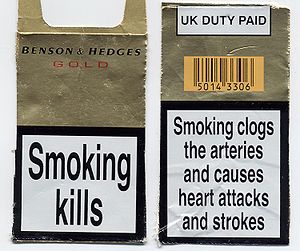
The front and back of a UK cigarette packet (i...
Image via Wikipedia

I had a bit of a rant at a Science Online London panel session on Saturday with Theo Bloom, Brian Derby, and Phil Lord which people seemed to like so it seemed worth repeating here. As usual when discussing scientific publishing the dreaded issue of the Journal Impact Factor came up. While everyone complains about metrics I’ve found that people in general seem remarkably passive when it comes to challenging their use. Channeling Björn Brembs more than anything else I said something approximately like the following.

It seems bizarre that we are still having this discussion. Thomson-Reuters say that the JIF shouldn’t be used for judging individual researchers, Eugene Garfield, the man who invented the JIF has consistently said it should never be used to judge individual researchers. Even a cursory look at the basic statistics should tell any half-competent scientist with an ounce of quantitative analysis in their bones that the Impact Factor of journals in which a given researcher publishes tells you nothing whatsoever about the quality of their work.

Metrics are unlikely to go away – after all, if we didn’t have them we might have to judge people’s work by actually reading it – but as professional measurers and analysts of the world we should be embarrassed to use JIFs to measure people and papers. It is quite simply bad science. It is also bad management. If our managers and leaders have neither the competence nor the integrity to use appropriate measurement tools then they should be shamed into doing so. If your managers are not competent to judge the quality of your work without leaning on spurious measures your job and future is in serious jeopardy. But more seriously, if as professional researchers we don’t have the integrity to challenge the fundamental methodological flaws in using JIFs to judge people and the appalling distortion of scientific communication that this creates then I question whether our own research methodology can be trusted either.

My personal belief is that we should be focussing on developing effective and diverse measures of the re-use of research outputs. By measuring use rather than merely prestige we can go much of the way of delivering on the so-called impact agenda, optimising our use of public funds to generate outcomes but while retaining some say over the types of outcomes that are important and what timeframes they are measured over. But whether or not you agree with my views it seems to me critical that we, as hopefully competent scientists, at least debate what it is we are trying to optimise and what are the appropriate things we should be trying to measure so we can work on providing reliable and sensible ways of doing that.

Enhanced by Zemanta

1 Star2 Stars3 Stars4 Stars5 Stars (No Ratings Yet)
Loading ... Loading ...

  • http://friendfeed.com/billhooker Bill Hooker

    "…as professional measurers and analysts of the world we should be embarrassed to use JIFs to measure people and papers. It is quite simply bad science." Hear, hear!

    This comment was originally posted on FriendFeed

  • http://friendfeed.com/steelgraham Graham Steel

    Totally OT – I would gladly pay to watch Aussies, Bill and Cameron play tennis (other games may be applicable) and all the proceeds be donated to a worthy cause. #anyonefortennis?

    This comment was originally posted on FriendFeed

  • http://friendfeed.com/brembs Björn Brembs

    Ironically enough, just yesterday I filled in a form required for an application for a professorship, where they wanted to know how many papers I had in which IF journals. Should I be interviewed, this particular position would be so important for me, that for the first time ever, I would probably not say anything about this embarrassing use of the IF, which would normally disqualify them as employers immediately.

    This comment was originally posted on FriendFeed

  • http://friendfeed.com/egonw Egon Willighagen

    Björn, was that Göteborg? I was trying to find the details, but they are apparently using that as part of the officiel job application process… did not find those details yet, though…

    This comment was originally posted on FriendFeed

  • http://friendfeed.com/brembs Björn Brembs

    Now, and that makes it even more embarrassing, it was here in Berlin. When I interviewed in Uppsala I did not see any of this nonsense. If I get the professorship, you can be sure there’ll be a lecture or two about IFs. And there will be figures with forms from certain universities…

    This comment was originally posted on FriendFeed

  • http://friendfeed.com/brembs Björn Brembs

    This whole sad discussion reminds me: why isn’t there a tool available, that allows people to construct their own citation list??? I’ve been doing this by hand for years now: http://bjoern.brembs.net/citations.php

    This comment was originally posted on FriendFeed

  • http://ouseful.info Anonymous

    I used to play with evolving classifier systems, back when i did “proper” research. One of the algorithms used to promote rules was a bucket brigade algorithm, that apportioned credit to rules that set up other rules that then received some sort of payoff.

    Under this sort of approach, a coupled sets of questions are: what makes for tangible rewards and credit apportionment in research? Alternatively, do we need to come up with some other reputation frameworks? How would one based on pay-it-forward work, for example?

  • http://friendfeed.com/billhooker Bill Hooker

    Bjoern, have you tried PoP http://www.harzing.com/pop.htm?

    This comment was originally posted on FriendFeed

  • http://friendfeed.com/brembs Björn Brembs

    Yes, I use it, but it only pulls from GS which is neither as user friendly nor as ‘accurate’ as WoS/Scopus. So I use all three, de-duplicate by hand, copy and paste into an HTML editor and format (also by hand). I don’t know of any other way to do this. To stay on topic: I think this is currently the best way to replace IF counts when evaluating people: use actual citations.

    This comment was originally posted on FriendFeed

  • http://friendfeed.com/freesci Pawel Szczesny

    In Poland JIF is used every single time scientists are evaluated (whether it’s a grant or a new position). Also, quite often a lecturer on a science seminar is introduced with mentioning his "total IF points". We have also "ministry points" (from Ministry of Science). These are awarded in the same manner as IF – per publication (points are also awarded for writing a syllabus for a course one’s teaching). Because it’s not a continuous scale but a few buckets, questions like "how many papers in X equal to one in Nature/Science/Cell?" are easily answered (and of course asked frequently). Citations? Who cares about that? ;)

    This comment was originally posted on FriendFeed

  • http://friendfeed.com/freesci Pawel Szczesny

    In Poland JIF is used every single time scientists are evaluated (whether it’s a grant or a new position). Also, quite often a lecturer on a science seminar is introduced with mentioning her/his "total IF points". We have also "ministry points" (from Ministry of Science). These are awarded in the same manner as IF – per publication (points are also awarded for writing a syllabus for a course one’s teaching). Because it’s not a continuous scale but a few buckets, questions like "how many papers in X equal to one in Nature/Science/Cell?" are easily answered (and of course asked frequently). Citations? Who cares about that? ;)

    This comment was originally posted on FriendFeed

  • http://friendfeed.com/cameronneylon Cameron Neylon

    @Björn We’re working on something with the intention of delivering this and PM-R has been arguing a lot recently for open citations and open metrics.

    This comment was originally posted on FriendFeed

  • http://friendfeed.com/cameronneylon Cameron Neylon

    I would have thought that using JIF in a job application process would open an organization up to being sued…

    This comment was originally posted on FriendFeed

  • http://friendfeed.com/cameronneylon Cameron Neylon

    @Pawel – that was kind of the basis of the prestige vs outcomes riff that I most recently wrote about in the interview with Michael. It’s a perfectly reasonable decision for a country, particularly a small country to go for prestige as a way of making a mark. But they shouldn’t expect that to lead to either a viable, stable, or particularly valuable research community. If you want those things then you need to optimise for them (which is harder to measure obviously, but most important things are)

    This comment was originally posted on FriendFeed

  • http://friendfeed.com/kubke Kubke

    I was thinking the other day about changing my cv and instead of listing ‘my publications’ start listing the papers that cite my papers (first order) and those that cite those first order papers (second order)) (or some quantification of that sort based on ‘order’). A visualization of it could be fun to do too. Then I start wondering whether I should wait until I am out of my continuation period ….

    This comment was originally posted on FriendFeed

  • http://friendfeed.com/egonw Egon Willighagen

    @Kubke… agreed… if your research published in a low ranking journal but used significantly in Nature X publications, what JIF should you fairly take… should we perhaps make a black list of universities where JIFs are used? it seems that SHOUTING is the only way to get things changed these days… :(

    This comment was originally posted on FriendFeed

  • http://friendfeed.com/kubke Kubke

    @Egon :) I am on the advisory board for creative commons Aotearoa New Zealand, and one thing that came up is that ‘opening up’ requires a serious change in assessment policies. One example: Lets say someone gets 1000 citations on nature preceedings (not peer reviewed) shouldn’t that count more than zero or 1 citation on a ‘peer reviewed’ nature? Should we move from ‘peer reviewed’ to ‘peer accepted’?

    This comment was originally posted on FriendFeed

  • http://friendfeed.com/steelgraham Graham Steel

    "Should we move from ‘peer reviewed’ to ‘peer accepted’?"

    This comment was originally posted on FriendFeed

  • http://friendfeed.com/kubke Kubke

    @Graham or ‘peer uptake’

    This comment was originally posted on FriendFeed

  • http://friendfeed.com/baoilleach Noel O’Boyle

    And depending on who your peers are, we could have top peer, instead of top tier.

    This comment was originally posted on FriendFeed

  • http://friendfeed.com/brembs Björn Brembs

    What if the citing papers all cite the paper to dismiss it, or because it was shown to be fraudulent? You’d need either a citation typology or he possibility to retract papers from the record, the latter being difficult in non-peer-reviewed archives.

    This comment was originally posted on FriendFeed

  • http://friendfeed.com/brembs Björn Brembs

    @Cameron: Looking forward to that tool!

    This comment was originally posted on FriendFeed

  • http://friendfeed.com/cameronneylon Cameron Neylon

    @Björn It’s not so much the tool. That’s pretty trivial. It’s getting hold of the data that is the problem…. but that’s what the project is about.

    This comment was originally posted on FriendFeed

  • http://friendfeed.com/jandot Jan Aerts

    = y". Which obviously completely bypasses my open-source work… But at this point in my career there is nothing much that I can do.

    This comment was originally posted on FriendFeed

  • http://friendfeed.com/cameronneylon Cameron Neylon

    x will only get you into rubbish places. The best places will want you to explain why those papers (and the rest of your work) are important, not just some numbers. But bottom line, I think you’re in a hard place, and you need to play the game. I appreciate the problem and I appreciate the freedom I have in being able to sound off about it.

    This comment was originally posted on FriendFeed

  • http://friendfeed.com/mummi ‘Mummi’ Thorisson

    @Björn wrt. citation typology: here’s a recent paper on this very topic: Shotton. CiTO, the Citation Typing Ontology. Journal of Biomedical Semantics 2010, 1(Suppl 1):S6 http://dx.doi.org/10.1186/2041-1480-1-S1-S6 "..ontology for describing the nature of reference citations in scientific research articles and other scholarly works, both to other such publications and also to Web information resources, and for publishing these descriptions on the Semantic Web. .."

    This comment was originally posted on FriendFeed

  • http://friendfeed.com/brembs Björn Brembs

    @Mummi: nice! This sort of technology needs to be developed and incorporated in citation analyses are to progress.

    This comment was originally posted on FriendFeed