Sci – Bar – Foo etc. Part III – Google Wave Session at SciFoo

Google Wave has got an awful lot of people quite excited. And others are more sceptical. A lot of SciFoo attendees were therefore very excited to be able to get an account on the developer sandbox as part of the weekend. At the opening plenary Stephanie Hannon gave a demo of Wave and, although there were numerous things that didn’t work live, that was enough to get more people interested. On the Saturday morning I organized a session to discuss what we might do and also to provide an opportunity for people to talk about technical issues. Two members of the wave team came along and kindly offered their expertise, receiving a somewhat intense grilling as thanks for their efforts.

I think it is now reasonably clear that there are two short to medium term applications for Wave in the research process. The first is the collaborative authoring of documents and the conversations around those. The second is the use of wave as a recording and analysis platform. Both types of functionality were discussed with many ideas for both. Martin Fenner has also written up some initial impressions.

Naturally we recorded the session in Wave and even as I type, over a week later, there is a conversation going in real time about the details of taking things forward. There are many things to get used to, not leastwhen it is polite to delete other people’s comments and clean them up, but the potential (and the weaknesses and areas for development) are becoming clear.

I’ve pasted our functionality brainstorm at the bottom to give people an idea of what we talked about but the discussion was very wide ranging. Functionality divided into a few categories. Firstly Robots for bringing scientific objects, chemical structures, DNA sequences, biomolecular structures, videos, and images into the wave in a functional form with links back to a canonical URI for the object. In its simplest form this might just provide a link back to a database. So typing “chem:benzene” or “pdb:1ecr” would trigger a robot to insert a link back to the database entry. More complex robots could insert an image of the chemical (or protein structure) or perhaps rdf or microformats that provide a more detailed description of the molecule.

Taking this one step further we also explored the idea of pulling data or status information from larboratory instruments to create a “laboratory dashboard” and perhaps controlling them. This discussion was helpful in getting a feel for what Wave can and can’t do as well as how different functionalities are best implemented. A robot can be built to populate a wave with information or data from laboratory instruments and such a robot could also pass information from the wave back to the instrument in principle. However both of these will still require some form of client running on the instrument side that is capable of talking to the robot web service. So the actual problem of interfacing with the instrument will remain. We can hope that instrument manufacturers might think of writing out nice simple XML log files at some point but in the meantime this is likely to involve hacking things together. If you can manage this then a Gadget will provide a nice way of providing a visual dashboard type interface to keep you updated as to what is happening.

Sharing data analysis is something of significant interest to me and the fact that there is already a robot (called Monty) that will intepret Python is a very interesting starting point for exploring this. There is some basic graphing functionality (Graphy naturally). For me this is where some of the most exciting potential lies; not just sharing printouts or the results of data analysis procedures but the details of the data and a live representation of the process that lead to the results. Expect much more from me on this in the future as we start to take it forward.

The final area of discussion, and the one we probably spent the most time on, was looking at Wave in the authoring and publishing process. Formatting of papers, sharing of live diagrams and charts, automated reference searching and formatting, as well as submission processes, both to journals and to other repositories, and even the running of peer review process were all discussed. This is the area where the most obvious and rapid gains can be made. In a very real sense Wave was designed to remove the classic problem of sending around manuscript versions with multiple figure and data files by email so you would expect it to solve a number of the obvious problems. The interesting thing in my view will be to try it out in anger.

Which was where we finished the session. I proposed the idea of writing a paper, in Wave, about the development and application of tools needed to author papers in Wave. As well as the technical side, such a paper would discuss the user experience, and any of the social issues that arise out of such a live collaborative authoring experience. If it were possible to run an actual peer review process in Wave that would also be very cool however this might not be feasible given existing journal systems. If not we will run a “mock” peer review process and look at how that works. If you are interested in being involved, drop a note in the comments, or join the Google Group that has been set up for discussions (or if you have a developer sandbox account and want access to the Wave drop me a line).

There will be lots of details to work through but the overall feel of the session for me was very exciting and very positive. There will clearly be technical and logistical barriers to be overcome. Not least that a a significant quantity of legacy toolingmay not be a good fit for Wave. Some architectural thinking on how to most effectively re-use existing code may be required. But overall the problem seems to be where to start on the large set of interesting possibilities. And that seems a good place to be with any new technology.

Continue reading “Sci – Bar – Foo etc. Part III – Google Wave Session at SciFoo”

Science 2.0 in Toronto – MaRS Centre 29 July

Greg Wilson has put together an amazing set of speakers for a symposium entitled – “Science 2.0: What every scientist needs to know about how the web is changing the way they work“. It is very exciting for me to be sharing a platform with Michael Nielsen, Victoria Stodden, Titus Brown, David Rich and Jon Udell. The full details are available at the link. The event is free but you need to register in advance.

  • Titus Brown: Choosing Infrastructure and Testing Tools for Scientific Software Projects
  • Cameron Neylon: A Web Native Research Record: Applying the Best of the Web to the Lab Notebook
  • Michael Nielsen: Doing Science in the Open: How Online Tools are Changing Scientific Discovery
  • David Rich: Using “Desktop” Languages for Big Problems
  • Victoria Stodden: How Computational Science is Changing the Scientific Method
  • Jon Udell: Collaborative Curation of Public Events

Sci – Bar – Foo etc. Part I – SciBarCamp Palo Alto

Last week I was lucky enough to attend both SciBarCamp Palo Alto and SciFoo; both for the second time. In the next few posts I will give a brief survey of the highlights of both, kicking off with SciBarCamp. I will follow up with more detail on some of the main things to come out of these meetings over the next week or so.

SciBarCamp followed on from last year’s BioBarCamp and was organized by Jamie McQuay, John Cumbers, Chris Patil, and Shirley Wu. It was held at the Institute for the Future at Palo Alto which is a great space for a small multisession meeting for about 70 people.

A number of people from last year’s camp came but there was a good infusion of new people as well with a strong element of astronomy and astonautics as well as a significant number of people with one sort of media experience or another who were interested in science providing a different kind of perspective.

After introductions and a first past at the session planning the meeting was kicked off by a keynote from Sean Mooney on web tools for research. The following morning kicked off for me with a session lead by Chris Patil on Open Source text books with an interesting discussion on how to motivate people to develop content. I particularly liked the notion of several weeks in a pleasant place drinking cocktails hammering out the details of the content. Joanna Scott and Andy Lang gave a session on the use of Second Life for visualization and scientific meetings. You can see Andy’s slides at slideshare.

Tantek Celik gave a session on how to make data available from a technical perspective with a focus on microformats as a means of marking up elements. His list of five key points for publishing data on the web make a good checklist. Unsurprisingly, being a key player at microformats.org he played up microformats. There was a pretty good discussion, that continued through some other sessions, on the relative value of microformats versus XML or rdf. Tantik was dismissive which I would agree with for much of the consumer web, but I would argue that the place where semantic web tools are starting to make a difference is the sciences and the microformats, at least in their controlled vocabulary form, are unlikely to deliver. In any case a discussion worth having, and continuing.

An excellent Indian lunch (although I would take issue with John’s assertion that it was the best outside of Karachi, we don’t do too badly here in the UK), was followed by a session from Alicia Grubb on Scooping, Patents, and Open Science. I tried to keep my mouth shut and listen but pretty much failed. Alicia is also running a very interesting project looking at researcher’s attitudes towards reproducibility and openness. Do go and fill out her survey. After this (or actually maybe it was before – it’s becoming a blur) Pete Binfield ran a session on how (or whether) academic publishers might survive the next five years. This turned into a discussion more about curation and archival than anything else although there was a lengthy discussion of business models as well.

Finally myself, Jason Hoyt, and Duncan Hull did a tag team effort entitled “Bending the Internet to Scientists (not the other way around)“. I re-used the first part of the slides from my NESTA Crucible talk to raise the question of how we maximise the efficiency of the public investment in research. Jason talked about why scientists don’t use the web, using Mendeley as an example of trying to fit the web to scientists’ needs rather than the other way around, and Duncan closed up with discussion of online researcher identities. Again this kicked off an interesting discussion.

Video of several sessions is available thanks to Naomi Most. The friendfeed room is naturally chock full of goodness and there is always a Twitter search for #sbcPA. I missed several sessions which sounded really interesting, which is the sign of a great BarCamp. It was great to catch up with old friends, finally meet several people who I know well from online, as well as meet a whole new bunch of cool people. As Jamie McQuay said in response to Kirsten Sanford, it’s the attendees that make these conferences work. Congrats to the organizers for another great meeting. Here’s looking forward to next year.

Some slides for granting permissions (or not) in presentations

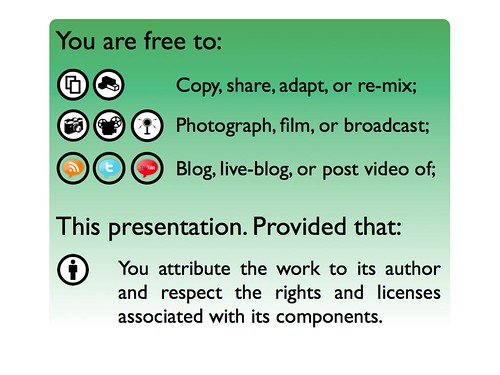
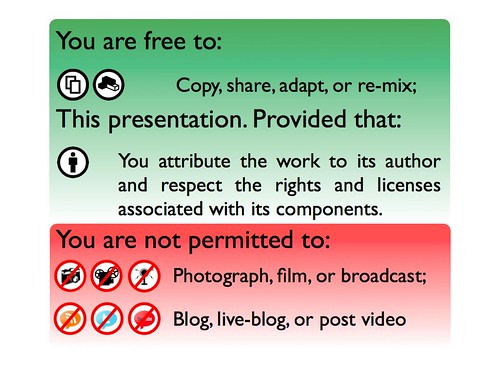
A couple of weeks ago there was a significant fracas over Daniel MacArthur‘s tweeting from a Cold Spring Harbour Laboratory meeting.  This was followed in pretty quick succession by an article in Nature discussing the problems that could be caused when the details of presentations no longer stop at the walls of the conference room and all of these led to a discussion (see also friendfeed discussions) about how to make it clear whether you are happy or not with your presentation being photographed, videoed, or live blogged. A couple of suggestions were made for logos or icons that might be used.

I thought it might be helpful rather than a single logo to have a panel that allows the presenter to permit some activities but not others and put together a couple of mockups.

Permission to do whatever with presentationPermission to do less with presentation

I’ve also uploaded a PowerPoint file with the two of these as slides to Slideshare which should enable you to download, modify, and extract the images as you wish. In both cases they are listed as having CC-BY licences but feel free to use them without any attribution to me.

In some of the Friendfeed conversations there are some good comments about how best to represent and suggestions on possible improvements. In particular Anders Norgaard suggests a slightly more friendly “please don’t” rather than my “do not”. Entirely up to you, but I just wanted to get these out. At the moment these are really just to prompt discussion but if you find them useful then please re-post modified versions for others to use.

[Ed. The social media icons are from Chris Ross and are by default under a GPL license. I have a request in to make them available to the Public Domain or as CC-BY at least for re-use. And yes I should have picked this up before.]

Conferences as Spam? Liveblogging science hits the mainstream

I am probably supposed to be writing up some weighty blog post on some issue of importance but this is much more fun. Last year’s International Conference on Intelligent Systems for Molecular Biology (ISMB) kicked off one of the first major live blogging exercises in a mainstream biology conference. It was so successful that the main instigators were invited to write up the exercise and the conference in a paper in PLoS Comp Biol. This year, the conference organizers, with significant work from Michael Kuhn and many others, have set up a Friendfeed room and publicised this from the off, with the idea of supporting a more “official”, or at least coordinated process of disseminating the conference to the wider world. Many have been waiting in anticipation for the live blogging to start due to logistical or financial difficulties in attending in person.

However, there were also concerns. Many of the original ring leaders were not attending. With the usual suspects confined to their home computers would the general populace take up the challenge and provide the rich feed of information the world was craving? Things started well, then moved on rapidly as the room filled up. But the question as to whether it was sustainable was answered pretty effectively when the Friendfeed room went suddenly quiet. Fear gripped the microbloggers. Could the conference go on? Gradually the technorati figured out they could still post by VPNing to somewhere else. Friendfeed was blocking the IP corresponding to the conference wireless network. So much traffic was being generated it looked like spam! This has now been corrected, and normal service resumed, but in a funny and disturbing kind of way it seems to me like a watershed. There were enough people, and certainly not just the usual suspects, live blogging a scientific conference that the traffic looked like spam. Ladies and Gentleman. Welcome to the mainstream.

Talking to the next generation – NESTA Crucible Workshop

Yesterday I was privileged to be invited to give a talk at the NESTA Crucible Workshop being held in Lancaster. You can find the slides on slideshare. NESTA, the National Endowment for Science, Technology, and the Arts,  is an interesting organization funded via a UK government endowment to support innovation and enterprise and more particularly the generation of a more innovative and entrepreneurial culture in the UK. Among the programmes it runs in pursuit of this is the Crucible program where a small group of young researchers, generally looking for or just in their first permanent or independent positions, attend a series of workshops to get them thinking broadly about the role of their research in the wider world and to help them build new networks for support and collaboration.

My job was to talk about “Science in Society” or “Open Science”. My main theme was the question of how we justify taxpayer expenditure on research; that to me this implies an obligation to maximise the efficiency of how we do our research. Research is worth doing but we need to think hard about how and what we do. Not surprisingly I focussed on the potential of using web based tools and open approaches to make things happen cheaper, quicker, and more effectively. To reduce waste and try to maximise the amount of research output for the money spent.

Also not surprisingly there was significant pushback – much of it where you would expect. Concerns over data theft, over how “non-traditional” contributions might appear (or not) on a CV, and over the costs in time were all mentioned. However what surprised me most was the pushback against the idea of putting material on the open web versus traditional journal formats. There was a real sense that the group had a respect for the authority of the printed, versus online, word which really caught me out. I often use a gotcha moment in talks to try and illustrate how our knowledge framework is changed by the web. It goes “how many people have opened a physical book for information in the last five years?”. Followed by “and how many haven’t used Google in the last 24 hours”. This is shamelessly stolen from Jamie Boyle incidentally.

Usually you get three or four sheepish hands going up admitting a personal love of real physical books. Generally it is around 5-10% of the audience, and this has been pretty consistent amongst mid-career scientists in both academia and industry, and people in publishing. In this audience about 75% put their hands up.  Some of these were specialist “tool” books, mathematical forms, algorithmic recipes, many of them were specialist texts and many referred to the use of undergraduate textbooks. Interestingly they also brought up an issue that I’ve never had an audience bring up before; that of how do you find a good route into a new subject area that you know little about, but that you can trust?

My suspicion is that this difference comes from three places, firstly that these researchers were already biased towards being less discipline bound by the fact that they’d applied for the workshop. They were therefore more likely to discipline hoppers,  jumping into new fields where they had little experience and needed a route in. Secondly, they were at a stage of their career where they were starting to teach, again possibly slightly outside their core expertise and therefore looking for good, reliable material, to base their teaching on. Finally though there was a strong sense of respect for the authority of the printed word. The printing of the German Wikipedia was brought up as evidence that printed matter was, at least perceived to be, more trustworthy. Writing this now I am reminded of the recent discussion on the hold that the PDF has over the imagination of researchers. There is a real sense that print remains authoritative in a way that online material is not. Even though the journal may never be printed the PDF provides the impression that it could or should be. I would guess also that the group were young enough also to be slightly less cynical about authority in general.

Food for thought, but it was certainly a lively discussion. We actually had to be dragged off to lunch because it went way over time (and not I hope just because I had too many slides!). Thanks to all involved in the workshop for such an interesting discussion and thanks also to the twitter people who replied to my request for 140 character messages. They made a great way of structuring the talk.

Pub-sub/syndication patterns and post publication peer review

I think it is fair to say that even those of us most enamored of post-publication peer review would agree that its effectiveness remains to be demonstrated in a convincing fashion. Broadly speaking there are two reasons for this; the first is the problem of social norms for commenting. As in there aren’t any. I think it was Michael Nielsen who referred to the “Kabuki Dance of scientific discourse”. It is entirely allowed to stab another member of the research community in the back, or indeed the front, but there are specific ways and forums in which it is acceptable to do. No-one quite knows what the appropriate rules are for commenting on online fora, as best described most recently by Steve Koch.

My feeling is that this is a problem that will gradually go away as we evolve norms of behaviour in specific research communities. The current “rules” took decades to build up. It should not be surprising if it takes a few years or more to sort out an adapted set for online interactions. The bigger problem is the one that is usually surfaced as “I don’t have any time for this kind of thing”. This in turn can be translated as, “I don’t get any reward for this”. Whether that reward is a token for putting on your CV, actual cash, useful information coming back to you, or just the warm feeling that someone else found your comments useful, rewards are important for motivating people (and researchers).

One of the things that links these two together is a sense of loss of control over the comment. Commenting on journal web-sites is just that, commenting on the journal’s website. The comment author has “given up” their piece of value, which is often not even citeable, but also lost control over what happens to their piece of content. If you change your mind, even if the site allows you to delete it, you have no way of checking whether it is still in the system somewhere.

In a sense, when the Web 2.0 world was built it was got nearly precisely wrong for personal content. For me Jon Udell has written most clearly about this when he talks about the publish-subscribe pattern for successful frameworks. In essence I publish my content and you choose to subscribe to it. This works well for me, the blogger, at this site, but it is not so great for the commenter who has to leave their comment to my tender mercies on my site. It would be better if the commenter could publish their comment and I could syndicate it back to my blog. This creates all sorts of problems; it is challenging for you to aggregate your own comments together and you have to rely on the functionality of specific sites to help you follow responses to your comments. Jon wrote about this better than I can in his blog post.

So a big part of the problem could be solved if people streamed their own content. This isn’t going to happen quickly in the general sense of everyone having a web server of their own – it still remains too difficult for even moderately skilled people to be bothered doing this. Services will no doubt appear in the future but current broadcast services like twitter offer a partial solution (its “my” twitter account, I can at least pretend to myself that I can delete all of it). The idea of using something like the twitter service at microrevie.ws as suggested by Daniel Mietchen this week can go a long way towards solving the problem. This takes a structured tweet of the form @hreview {Object};{your review} followed optionally by a number of asterisks for a star rating. This doesn’t work brilliantly for papers because of problems with the length of references for the paper, even with shortened dois, the need for sometimes lengthy reviews and the shortness of tweets. Additionally the twitter account is not automatically associated with a unique research contributor ID. However the principle of the author of the review controlling their own content, while at the same time making links between themselves and that content in a linked open data kind of way is extremely powerful.

Imagine a world in which your email outbox or local document store is also webserver (via any one of an emerging set of tools like Wave, DropBox, or Opera Unite). You can choose who to share your review with and change that over the time. If you choose to make it public the journal, or the authors can give you some form of credit. It is interesting to think that author-side charges could perhaps be reduced for valuable reviews. This wouldn’t work in a naive way, with $10 per review, because people would churn out  large amounts of rubbish reviews, but if those reviews are out on the linked data web then their impact can be measured by their page rank and the authors rewarded accordingly.

Rewards and control linked together might provide a way of solving the problem – or at least of solving it faster than we are at the moment.

Why the Digital Britain report is a missed opportunity

A few days ago the UK Government report on the future of Britain’s digital infrastructure, co-ordinated by Lord Carter, was released. I haven’t had time to read the whole report, I haven’t even really had time to skim it completely. But two things really leapt out at me.

On page four:

“If, as expected, the volume of digital content will increase 10x to 100x over the next 3 to 5 years then we are on the verge of a big bang in the communications industry that will provide the UK with enormous economic and industrial opportunities”

And on page 18:

“Already today around 7.5% of total UK music album purchases are digital and a smaller but rapidly increasing percentage of film and television consumption is streamed online or downloaded…User-generated and social content will be very significant but should not be the main or only content” – this brought to my attention by Brian Kelly.

The first extract, is to me symptomatic of a serious, even catastrophic lack of ambition and understanding of how the web is changing. If the UK’s digital content only increases by 10-100 fold over the next three years then we will be living in a country lagging behind those that will be experiencing huge economic benefits from getting the web right for their citizens.

But that is just a lack of understanding at core. The Government’s lack of appreciation for how fast this content is growing isn’t really an issue because the Government isn’t an effective content producer online. It would be great if it were, pushing out data, making things happen but they will probably catch up one day, when forced to by events. What is disturbing to me is that second passage. “User generated and social content should not be the main or only content”? It probably already is the main content on the open web, at least by volume, and the volume and traffic rates of user generated content are rising exponentially. But putting that aside, the report appears to be saying that basically the content generated by British citizens, is not, and will not be “good enough”; that it has no real value. Lord Carter hasn’t just said that he doesn’t believe that enough useful content could be produced by “non-professionals”, but that it shouldn’t be produced.

The Digital Britain Unconferences were a brilliant demonstration of how the web can enable democracy by bringing interested people together to debate and respond to specific issues. Rapid, high quality, and grass roots it showed the future of how government’s could actually interact effectively with their citizens. The potential for economic benefits from the web are not in broadcast, are not in professional production, but are in many to many communication and sharing. Selling a few more videos will not get us out of this recession. Letting millions of people add a small amount of value, or have more efficient interactions, could. This report fails to reflect that opportunity. It is a failure of understanding and a failure of imagination. The only saving grace is that, aside from the need for physical infrastructure, the Government is becoming increasingly irrelvant to the debate anyway. The world will move on, and the web will enable it, faster or slower than we expect, and in ways that will be suprising. It will just go that much slower in the UK.

Google Wave in Research – Part II – The Lab Record

In the previous post  I discussed a workflow using Wave to author and publish a paper. In this post I want to look at the possibility of using it as a laboratory record, or more specifically as a human interface to the laboratory record. There has been much work in recent years on research portals and Virtual Research Environments. While this work will remain useful in defining use patterns and interface design my feeling is that Wave will become the environment of choice, a framework for a virtual research environment that rewrites the rules, not so much of what is possible, but of what is easy.

Again I will work through a use case but I want to skip over a lot of what is by now I think becoming fairly obvious. Wave provides an excellent collaborative authoring environment. We can explicitly state and register licenses using a robot. The authoring environment has all the functionality of a wiki already built in so we can assume that and granular access control means that different elements of a record can be made accessible to different groups of people. We can easily generate feeds from a single wave and aggregate content in from other feeds. The modular nature of the Wave, made up of Wavelets, themselves made up of Blips, may well make it easier to generate comprehensible RSS feeds from a wiki-like environment. Something which has up until now proven challenging. I will also assume that, as seems likely, both spreadsheet and graphing capabilities are soon available as embedded objects within a Wave.

Let us imagine an experiment of the type that I do reasonably regularly, where we use a large facility instrument to study the structure of a protein in solution. We set up the experiment by including the instrument as a participant in the wave. This participant is a Robot which fronts a web service that can speak to the data repository for the instrument. It drops into the Wave a formatted table which provides options and spaces for inputs based on a previously defined structured description of the experiment. In this case it calls for a role for this particular run(is it a background or an experimental sample?) and asks where the description of the sample is.

The purification of the protein has already been described in another wave. As part of this process a wavelet was created that represents the specific sample we are going to use. This sample can be directly referenced via a URL that points at the wavelet itself making the sample a full member of the semantic web of objects. While the free text of the purification was being typed in another Robot, this one representing a web service interface to appropriate ontologies, automatically suggested using specific terms adding links back to the ontology where suggestions were accepted, and creating the wavelets that describe specific samples.

The wavelet that defines the sample is dragged and dropped into the table for the experiment. This copying process is captured by the internal versioning system and creates in effect an embedded link back to the purification wave, linking the sample to the process that it is being used in. It is rather too much at this stage to expect the instrument control to be driven from the Wave itself but the Robot will sit and wait for the appropriate dataset to be generated and check with the user it has got the right one.

Once everyone is happy the Robot will populate the table with additional metadata captured as part of the instrumental process, create a new wavelet (creating a new addressable object) and drop in the data in the default format. The robot naturally also writes a description of the relationships between all the objects in an appropriate machine readable form (RDFa, XML, or all of the above) in a part of the Wave that the user doesn’t necessarily need to see. It may also populate any other databases or repositories as appropriate. Because the Robot knows who the user is it can also automatically link the experimental record back to the proposal for the experiment. Valuable information for the facility but not of sufficient interest to the user for them to be bothered keeping a good record of it.

The raw data is not yet in a useful form though, we need to process it, remove backgrounds, that kind of thing. To do this we add the Reduction Robot as a participant. This Robot looks within the wave for a wavelet containing raw data, asks the user for any necessary information (where is the background data to be subtracted) and then runs a web service that does the subtraction. It then writes out two new wavelets, one describing what it has done (with all appropriate links to the appropriate controlled vocab obviously), and a second with the processed data in it.

I need to do some more analysis on this data, perhaps fit a model to start with, so again I add another Robot that looks for a wavelet with the correct data type, does the line fit, once again writes out a wavelet that describes what it has done, and a wavelet with the result in it. I might do this several times, using a range of different analysis approaches, perhaps doing some structural modelling and deriving some parameter from the structure which I can compare to my analytical model fit. Creating a wavelet with a spreadsheet embedded I drag and drop the parameter from the model fit and from the structure and format the cells so that it shows green if they are within 5% of each other.

Ok, so far so cool. Lots of drag and drop and using of groovy web services but nothing that couldn’t be done with a bit of work with a Workflow engine like Taverna and a properly set up spreadsheet. I now make a copy of the wave (properly versioned, its history is clear as a branch off the original Wave) and I delete the sample from the top of the table. The Robots re-process and realize there is not sufficient data to do any processing so all the data wavelets and any graphs and visualizations, including my colour-coded spreadsheet  go blank. What have I done here? What I have just created is a versioned, provenanced, and shareable workflow. I can pass the Wave to a new student or collaborator simply by adding them as a participant. I can then work with them, watching as they add data, point out any mistakes they might make and discuss the results with them, even if they are on the opposite side of the globe. Most importantly I can be reasonably confident that it will work for them, they have no need to download software or configure anything. All that really remains to make this truly powerful is to wrap this workflow into a new Robot so that we can pass multiple datasets to it for processing.

When we’ve finished the experiment we can aggregate the data by dragging and dropping the final results into a new wave to create a summary we can share with a different group of people. We can tweak the figure that shows the data until we are happy and then drop it into the paper I talked about in the previous post. I’ve spent a lot of time over the past 18 months thinking and talking about how we capture what is going and at the same time create granular web-native objects  and then link them together to describe relationships between them. Wave does all of that natively and it can do it just by capturing what the user does. The real power will lie in the web services behind the robots but the beauty of these is that the robots will make using those existing web services much easier for the average user. The robots will observe and annotate what the user is doing, helping them to format and link up their data and samples.

Wave brings three key things; proper collaborative documents which will encourage referring rather than cutting and pasting; proper version control for documents; and document automation through easy access to webservices. Commenting, version control and provenance, and making a cut and paste operation actually a fully functional and intelligent embed are key to building a framework for a web-native lab notebook. Wave delivers on these. The real power comes with the functionality added by Robots and Gadgets that can be relatively easily configured to do analysis. The ideas above are just what I have though of in the last week or so. Imagination really is the limit I suspect.