It’s not information overload, nor is it filter failure: It’s a discovery deficit

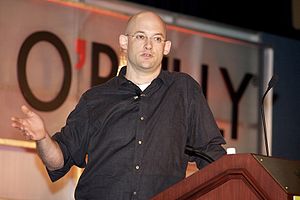
- Image via Wikipedia
Clay Shirky’s famous soundbite has helped to focus on minds on the way information on the web needs to be tackled and a move towards managing the process of selecting and prioritising information. But in the research space I’m getting a sense that it is fuelling a focus on preventing publication in a way that is analogous to the conventional filtering process involved in peer reviewed publication.
Most recently this surfaced at Chronicle of Higher Education, to which there were many responses, Derek Lowe’s being one of the most thought out. But this is not isolated.
@JISC_RSC_YH: How can we provide access to online resources and maintain quality of content? #rscrc10 [twitter via@branwenhide]
Me: @branwenhide @JISC_RSC_YH isn’t the point of the web that we can decouple the issues of access and quality from each other? [twitter]
There is a widely held assumption that putting more research onto the web makes it harder to find the research you are looking for. Publishing more makes discovery easier.
The great strength of the web is that you can allow publication of anything at very low marginal cost without limiting the ability of people to find what they are interested in, at least in principle. Discovery mechanisms are good enough, while being a long way from perfect, to make it possible to mostly find what you’re looking for while avoiding what you’re not looking for. Search acts as a remarkable filter over the whole web through making discovery possible for large classes of problem. And high quality search algorithms depend on having a lot of data.
It is very easy to say there is too much academic literature – and I do. But the solution which seems to be becoming popular is to argue for an expansion of the traditional peer review process. To prevent stuff getting onto the web in the first place. This is misguided for two important reasons. Firstly it takes the highly inefficient and expensive process of manual curation and attempts to apply it to every piece of research output created. This doesn’t work today and won’t scale as the diversity and sheer number of research outputs increases tomorrow. Secondly it doesn’t take advantage of the nature of the web. They way to do this efficiently is to publish everything at the lowest cost possible, and then enhance the discoverability of work that you think is important. We don’t need publication filters, we need enhanced discovery engines. Publishing is cheap, curation is expensive whether it is applied to filtering or to markup and search enhancement.
Filtering before publication worked and was probably the most efficient place to apply the curation effort when the major bottleneck was publication. Value was extracted from the curation process of peer review by using it reduce the costs of layout, editing, and printing through simple printing less. But it created new costs, and invisible opportunity costs where a key piece of information was not made available. Today the major bottleneck is discovery. Of the 500 papers a week I could read, which ones should I read, and which ones just contain a single nugget of information which is all I need? In the Research Information Network study of costs of scholarly communication the largest component of publication creation and use cycle was peer review, followed by the cost of finding the articles to read which represented some 30% of total costs. On the web, the place to put in the curation effort is in enhancing discoverability, in providing me the tools that will identify what I need to read in detail, what I just need to scrape for data, and what I need to bookmark for my methods folder.
The problem we have in scholarly publishing is an insistence on applying this print paradigm publication filtering to the web alongside an unhealthy obsession with a publication form, the paper, which is almost designed to make discovery difficult. If I want to understand the whole argument of a paper I need to read it. But if I just want one figure, one number, the details of the methodology then I don’t need to read it, but I still need to be able to find it, and to do so efficiently, and at the right time.
Currently scholarly publishers vie for the position of biggest barrier to communication. The stronger the filter the higher the notional quality. But being a pure filter play doesn’t add value because the costs of publication are now low. The value lies in presenting, enhancing, curating the material that is published. If publishers instead vied to identify, markup, and make it easy for the right people to find the right information they would be working with the natural flow of the web. Make it easy for me to find the piece of information, feature work that is particularly interesting or important, re-intepret it so I can understand it coming from a different field, preserve it so that when a technique becomes useful in 20 years the right people can find it. The brand differentiator then becomes which articles you choose to enhance, what kind of markup you do, and how well you do it.
All of these are things that publishers already do. And they are services that authors and readers will be willing to pay for. But at the moment the whole business and marketing model is built around filtering, and selling that filter. By impressing people with how much you are throwing away. Trying to stop stuff getting onto the web is futile, inefficient, and expensive. Saving people time and money by helping them find stuff on the web is an established and successful business model both at scale, and in niche areas. Providing credible and respected quality measures is a viable business model.
We don’t need more filters or better filters in scholarly communications – we don’t need to block publication at all. Ever. What we need are tools for curation and annotation and re-integration of what is published. And a framework that enables discovery of the right thing at the right time. And the data that will help us to build these. The more data, the more reseach published, the better. Which is actually what Shirky was saying all along…
Related articles by Zemanta
- Academic publishing is archaic (daniel-lemire.com)
- too much research (text-patterns.thenewatlantis.com)
- Clay Shirky’s COGNITIVE SURPLUS: how the net lets us share and do more than ever (boingboing.net)
- Cups, Buckets, Pools, and Puddles: When the Flood of Papers Won’t Abate, Which Do You Choose? (scholarlykitchen.sspnet.org)


Hmm, never occurred to me that people would take ‘filter failure’ to mean pre-publication, but the last spate of articles/posts indeed seems to indicate that. My impression is that we need some sort of powerful demonstration (YouTube video?) of how this discovery process can work. Just recently, a certain person in publishing referred to my description of it as ‘magic’. Clark’s third law aside, if people don’t understand the technical possibilities, how can we ever be convincing?
This comment was originally posted on FriendFeed
Seems to me more like an abundance of alliteration :-)
This comment was originally posted on FriendFeed
The single easiest way for publishers to make scientific information more discoverable would be to actually integrate the material properly with the web. The more hyperlinked papers are to each other, to the blogosphere, to news sites, and so on, the better search engines will be able to help us find what’s out there and worth reading. At the moment, almost no-one does this. PLoS does, somewhat, and it makes a huge difference already in Google. But the integration could go a lot further and be much more widespread.
This comment was originally posted on FriendFeed
The single easiest way for publishers to make scientific information more discoverable would be to actually integrate the material properly with the web. The more hyperlinked papers are to each other, to the blogosphere, to news sites, and so on, the better search engines will be able to help us find what’s out there and worth reading. At the moment, almost no publisher does this. Even the arXiv is essentially isolated from the web as a whole, and so we’re stuck wading through papers manually to find anything. PLoS is the only source I can think of offhand that makes much of an effort to integrate with the web, and it makes a huge difference already in Google. (PLoS articles could be far better hyperlinked, however.) But the integration ought to be much more widespread.
This comment was originally posted on FriendFeed
(cont) Until journals do this, I’ll have a hard time believing that they have any real interest in making it easier for scientists to locate high-quality information.
This comment was originally posted on FriendFeed
(cont) Until journals do this, I have a hard time believing that they have any real interest in making it easier for scientists to locate high-quality information.
This comment was originally posted on FriendFeed
(cont) Until journals do this, I’ll have a hard time believing that they have any real interest in making it easier for scientists to locate high-quality information. The notion of sorting by journal brand sort of made sense one hundred years ago; today, it’s ludicrous.
This comment was originally posted on FriendFeed
Björn – as I was writing this I was reminded of the "extraordinary power of data" meme which hadn’t been where I started. I think the argument that "more data makes better decisions" and therefore more publication will make better tools for finding stuff in all that published stuff could be quite powerful.
This comment was originally posted on FriendFeed
Björn – as I was writing this I was reminded of the "extraordinary power of data" meme which hadn’t been where I started. I think the argument that "more data makes better decisions" and therefore more publication will make better tools for finding stuff in all that published stuff could be quite powerful. Screencast of doing a google search should make the point?
This comment was originally posted on FriendFeed
Michael, yes agreed. Their whole business model is predicated on blocking access at the moment. I think the whole making the paper "of the web" is the key to effective communication in both directions – which speaks to the discussion on the OKF open science list as well. The end game really is that the publishers need to sort this out or Google will do it for them. And I think things will work out better for the research niche if there are players that do serve our particular needs.
This comment was originally posted on FriendFeed
The whole being summed up in Weinberger’s dictum "Filter on the way out, not on the way in", i.e. post-publicatioon.
This comment was originally posted on FriendFeed
…and alliteration may be the only way I’ll be able to compete with Shirky’s snappy soundbites so I’ll take anything I can get :-)
This comment was originally posted on FriendFeed
I was thinking more like a ‘today vs. tomorrow’ kind of thing. But maybe that’s a bad idea? I thought of showing how we are forced to struggle with the literature today (eToCs, press releases, WoK, GS, PubMed, etc. all isolated and with overlapping functionality and coverage, etc.) and then what it could look like tomorrow with the technology we already have.
This comment was originally posted on FriendFeed
Talking about discovery: I just read title and abstract of this paper: http://www.plosone.org/article/info%3Adoi%2F10.1371%2Fjournal.pone.0011667 I’m not going to read it, so I’m not going to comment on it, rate it or bookmark it. But I think a lot of people might also want to read title and abstract. Why isn’t there a flag for: ‘this might be interesting?’ And I mean that in general, not just for P1.
This comment was originally posted on FriendFeed
I like that, Björn. On one hand of course, reading just the Abstract = ‘don’t judge the book by the cover’ but on the other, a flag such as this at least leaves a recorded ‘stamp’. Interesting suggestion !
This comment was originally posted on FriendFeed
I like that, Björn. On one hand of course, reading just the Abstract (as we all know) = ‘don’t judge the book by the cover’ but on the other, a flag such as this at least leaves a recorded ‘stamp’. Interesting suggestion !
This comment was originally posted on FriendFeed
Like Bjoern, I’m gobsmacked that anyone thinks "filter failure" refers to pre-publication filtering. I suspect disingenuity and deliberate spreading of (F)UD on the part of publishers there. I also very much like the idea of demonstrating discovery. I have been told that I cannot possibly be reading the right papers if all I am relying on is my search strategies and not using journal impact factors to pick which papers to read!
This comment was originally posted on FriendFeed
OMG Bill that’s *insane*. It’s completely circular.
This comment was originally posted on FriendFeed
Maybe I don’t get it right, but to me ‘discovery deficit’ hides two quite different situations: when I know I need something and when I don’t know there’s something I need. The first is rather simple (technology is here) issue. The second situation is often called ‘ignorance’, but I wouldn’t mind to have it solved as well.
This comment was originally posted on FriendFeed
@Michael – I’m not sure that’s true. Google and other major search engines have arrangements with most publishers to index the full text of paywalled sites and it’s a poor journal platform that doesn’t link out references or, nowadays, to related news stories, articles or videos etc. I’m pretty sure that PLoS doesn’t gain any extra Google juice from being OA… though of course a larger audience will have the chance to read the content.
This comment was originally posted on FriendFeed
@Michael – I’m not sure that’s true. Google and other major search engines have arrangements with most publishers to index the full text of paywalled sites and it’s a poor journal platform that doesn’t link out references or, nowadays, to related news stories, articles or videos etc. I’m pretty sure that PLoS doesn’t gain any extra Google juice from being OA… though of course a larger audience will have the chance to actually read the content.
This comment was originally posted on FriendFeed
…. in fact STM publishers probably do *more* than most to make their content discoverable on the web – you get far richer metadata on many journal webpages than on, say, the NY Times. I think it’s more of a tools problem: search engines are only just starting to pay attention to stuff like RDFa and microformats.
This comment was originally posted on FriendFeed
…. in fact STM publishers probably do *more* than most to make their content discoverable on the web – you can far richer metadata on journal webpages than on, say, the NY Times. I think it’s more of a tools problem: search engines are only just starting to pay attention to stuff like RDFa and microformats.
This comment was originally posted on FriendFeed
…. in fact STM publishers probably do *more* than most to make their content discoverable on the web – you get far richer metadata on many journal webpages than on, say, the NY Times. I think it’s more of a tools problem: search engines are only just starting to pay attention to stuff like RDFa and microformats. Definitely getting better though….
This comment was originally posted on FriendFeed
PLoS gets plenty of indirect Googlejuice by being OA. Just check Ars Technica.
This comment was originally posted on FriendFeed
Liked “It’s not information overload, nor is it filter failure: It’s a discovery deficit” http://ff.im/-npKY1
This comment was originally posted on Twitter
@Pawel – agree those are two separate problems but if we had a real market people would be working on solving both of them with an eye to making money. @Bill Yep, I hear that one all the time. "If you’re not focussing on journals with high IF you’re not getting the good stuff"
This comment was originally posted on FriendFeed
@Euan don’t disagree with anything you say but I’m still going to call bullshit. If STM publishers were serious about building discovery in they would be putting at least rich snippets into every figure, demanding that the underlying data for every graph be made available _and_ exposed and that’s just for starters. No-one is doing that, not NPG (with a small number of honorourable exceptions) not Wiley, not Springer or Elsevier, and neither PLoS nor BMC. When a publisher make a serious effort to surface and expose underlying data I’ll laud it to the moon and back. But I’ve not seen anything much from anyone yet. It’s not easy and its not cheap but adding value never was. The point of markets is to squeeze margins. That’s what they do. The market makers create new spaces for value creation. Lets see a bit more of that.
This comment was originally posted on FriendFeed
Euan: speaking in broad brushstrokes, the journals are essentially a walled garden. Very few encourage hyperlinks out, from the main text of articles. I’ve lost count of the number of times I’ve had the text of URLs deleted from my references (never mind the actual link). And I don’t even both trying to include hyperlinks in the main text. And since the journals show no interest in linking to the outside world, and are so restrictive of access, it’s no surprise that no communities have built up offering commentaries (and links) to the journals from the outside. The journals may be on the web, but they’re not of the web. (I’m speaking in broad brushstrokes here, and there’s all kinds of details wrong when you get to the level of individual journals. But broadly speaking, I believe that what I’m saying is correct.)
This comment was originally posted on FriendFeed
Euan: speaking in broad brushstrokes, the journals are essentially a walled garden. Very few encourage hyperlinks out, from the main text of articles. I’ve lost count of the number of times I’ve had the text of URLs deleted from my references (never mind the actual link). And I don’t even bother trying to include hyperlinks in the main text, I know they’ll be deleted. And since the journals show no interest in linking to the outside world, and are so restrictive of access, it’s no surprise that no communities have built up offering commentaries (and links) to the journals from the outside. The journals may be on the web, but they’re not of the web. (I’m speaking in broad brushstrokes here, and there’s all kinds of details wrong when you get to the level of individual journals. But broadly speaking, I believe that what I’m saying is correct.)
This comment was originally posted on FriendFeed
Euan: speaking in broad brushstrokes, the journals are essentially a walled garden. Very few encourage hyperlinks out, from the main text of articles. I’ve lost count of the number of times I’ve had the text of URLs deleted from my references (never mind the actual link). And I don’t even bother trying to include hyperlinks in the main text. And since the journals show no interest in linking to the outside world, and are so restrictive of access, it’s no surprise that no communities have built up offering commentaries (and links) to the journals from the outside. The journals may be on the web, but they’re not of the web. (I’m speaking in broad brushstrokes here, and there’s all kinds of details wrong when you get to the level of individual journals. But broadly speaking, I believe that what I’m saying is correct.)
This comment was originally posted on FriendFeed
Sorry, that last comment reads harsher than I meant it. My point is there is a big gap between the current best standards, which don’t amount to much more than providing hyperlinks for references, and really optimising the ability of people to come to specific points in a paper for specific things. OA is an assumption here really because otherwise people can’t develop businesses to develop search and discovery tools – but beyond that we need much richer markup and layering of different "surfaces" that can be found and presented by those tools.
This comment was originally posted on FriendFeed
@Graham: so are we going to do it? If so, how? Could we come up with a script, have some people here leave a few comments and then think of a way to realize it?
This comment was originally posted on FriendFeed
I think there’s a disincentive in our current system that prevents development of discovery tools: where the article is published would become even less relevant than it is now if it fits your discovery criteria. OTOH, journal name could be one discovery criterion, so I may be wrong.
This comment was originally posted on FriendFeed
Liked “It’s not information overload, nor is it filter failure: It’s a discovery deficit” http://ff.im/-npKY1
This comment was originally posted on Twitter
Cameron, it’s not that publishers aren’t moving to provide the kind of amplification of data that you are telling Euan you want; it is that it takes longer to build into pre-existing platforms than I think is immediately obvious. (At least that’s what technology providers are telling me.) But I think you’ll begin to see some significant changes from content providers over the next 12 months.
This comment was originally posted on FriendFeed
this discussion dovetails nicely with another recent discussion on ff a few days ago on embedding bibliographic data into references. Jill is right that the publishers aren’t the leaders in this – the indexing and abstracting tools traditionally performed this function and they’re separate from the publishers (or were, before many of the mergers that have taken place). So we’re seeing this integration happen more slowly and with disconnects. And data, as Cameron noted, is much less developed than the references.
This comment was originally posted on FriendFeed
Björn, on "today vs tomorrow’: http://www.uic.edu/htbin/cgiwrap/bin/ojs/index.php/fm/article/view/2961/2573 .
This comment was originally posted on FriendFeed
@Daniel – That is the best contribution to this discussion so far. As we know has a research process at least four stages (probably more) http://dx.doi.org/10.1016/j.tibs.2009.02.002 . So, though we can discuss single stages do we have to acknowledge that the "research cycle" requires all stages to work properly, or we will face bottlenecks we "could" call a deficit. Still, it is not clear to me why this is the case, it might be well be that the deficit is caused by information overload or filter failure, at least I would assume some relationship between those concepts.
This comment was originally posted on FriendFeed
The current bottleneck is funding decisions – for everything else, open platforms exist, and I think it does not really matter into how many steps we decompose it (that table has 6, Cameron’s cycle 8).
This comment was originally posted on FriendFeed
[...] that inform scholars what’s groundbreaking across a broad set of fields. As the velocity and volume of science grow, this could be very [...]
Liked “It’s not information overload, nor is it filter failure: It’s a discovery deficit” http://ff.im/-npKY1
This comment was originally posted on Twitter
Maybe there should be then more "open funding" discussions, especially with focus on how to be fair in rewarding "open contributions"? Just a thought http://picasaweb.google.com/joergkurtwegner/JNJ_ESOF_ScienceBus_Day5#5491920120011684946 and "free riders" and "conditional collaborators" are a challenge http://picasaweb.google.com/joergkurtwegner/JNJ_ESOF_ScienceBus_Day5#5491920161634430738 since at the end people "might appera less altruistic than you think"!
This comment was originally posted on FriendFeed
Maybe there should be then more "open funding" discussions, especially with focus on how to be fair in rewarding "open contributions" (and at which of the 4,6,8,whatever stages the reward will occur, uh, that is a tricky one)? Just a thought http://picasaweb.google.com/joergkurtwegner/JNJ_ESOF_ScienceBus_Day5#5491920120011684946 and "free riders" and "conditional collaborators" are a challenge http://picasaweb.google.com/joergkurtwegner/JNJ_ESOF_ScienceBus_Day5#5491920161634430738 since at the end people "might appear less altruistic than you think"!
This comment was originally posted on FriendFeed
Maybe there should be then more "open funding" discussions, especially with focus on how to be fair in rewarding "open contributions"? Just a thought http://picasaweb.google.com/joergkurtwegner/JNJ_ESOF_ScienceBus_Day5#5491920120011684946 and "free riders" and "conditional collaborators" are a challenge http://picasaweb.google.com/joergkurtwegner/JNJ_ESOF_ScienceBus_Day5#5491920161634430738 since at the end people "might appear less altruistic than you think"!
This comment was originally posted on FriendFeed
@cameron yes, point taken about the lack of any publisher trailblazing – but being properly integrated with the web in 2010 *doesn’t* involve semantic enrichment, open data or changing the way scientists worldwide think about papers (unless you use a very different www to me). You’re talking raising the bar for anybody who deals with scholarly works (be it arXiv, Precedings, NPG, Elsevier, PLoS or PubMedCentral) – I agree, it should be raised, but it’d be wrong to say that publishers don’t also take the issue seriously already. it’s a hard problem and in addition to what Jill said not necessarily something you can or should do unilaterally…
This comment was originally posted on FriendFeed
@cameron yes, point taken about the lack of any publisher trailblazing – but being properly integrated on the web in 2010 *doesn’t* mean changing the way scientists worldwide think about papers, semantic enrichment and open data (unless you use a very different www to me). You’re talking raising the bar for anybody who deals with scholarly works (be it arXiv, Precedings, NPG, Elsevier, PLoS or PubMedCentral) – I agree, it should be raised, but it’d be wrong to say that publishers don’t already take the issue seriously – it’s a hard problem and in addition to what Jill said not necessarily something you can or should do unilaterally…
This comment was originally posted on FriendFeed
@cameron yes, point taken about the lack of any publisher trailblazing – but being properly integrated with the web in 2010 *doesn’t* involve semantic enrichment, open data or changing the way scientists worldwide think about papers (unless you use a very different www to me). You’re talking raising the bar for anybody who deals with scholarly works (be it arXiv, Precedings, NPG, Elsevier, PLoS or PubMedCentral) – I agree, it should be raised, but it’d be wrong to say that publishers don’t also take the issue seriously already. It’s a hard problem and in addition to what Jill said not necessarily something you can or should do unilaterally.
This comment was originally posted on FriendFeed
Just to complete the defending my commercial employer cliche ;) – not sure OA needs to be in the mix. You can have a scholarly search and discovery type business now (see DeepDyve, novoseek and most obviously Google / Google Scholar) you just need to sign more pain in the ass license agreements. I’d rather get the standards in place now and then worry about who’s going to use them later.
This comment was originally posted on FriendFeed
Also, to complete a cliche ;) – not sure OA needs to be in the mix. You can have a scholarly search and discovery type business now (see DeepDyve, novoseek and most obviously Google / Google Scholar) you just need to sign more pain in the ass license agreements. Better for projects to do this kind of thing to not bite off more than they can chew…
This comment was originally posted on FriendFeed
Liked “It’s not information overload, nor is it filter failure: It’s a discovery deficit” http://ff.im/-npKY1
This comment was originally posted on Twitter
Liked “It’s not information overload, nor is it filter failure: It’s a discovery deficit” http://ff.im/-npKY1
This comment was originally posted on Twitter
Liked “It’s not information overload, nor is it filter failure: It’s a discovery deficit” http://ff.im/-npKY1 #in http://ff.im/-nztjQ
This comment was originally posted on Twitter
What I read Michael Neilsen to be saying isn’t anything so much to do with semantics, RDFa, or any of those wonderful things under development, but rather integrating with the web 1.0. Links in a published research paper almost always go to somewhere else within that paper or on the publisher’s site, and rarely to another paper or another website. Even citation links go to the bibliography entry at the bottom of the paper instead of the actual paper being cited. Publishers have had almost 2 decades to get that right, so any argument saying essentially "it’s hard but we want to do it and we’re making progress" needs to be backed up a little better.
This comment was originally posted on FriendFeed
I agree Mr Gunn that the publishers keep the publication links sequestered. I would explain this by history – traditionally other outlets (like WoS, etc.) added this info. Even today I don’t think they feel it’s worth their time to do it, even if there’s promises to do so. The discipline-based abstract sources added interlinked citations earlier – I recall even these vendors took several years to add them after being on the web.
This comment was originally posted on FriendFeed
And now in chorus: "We don’t need publication filters, we need enhanced discovery engines."
This comment was originally posted on FriendFeed
And now in chorus: "We don’t need [pre-]publication filters, we need enhanced discovery engines."
This comment was originally posted on FriendFeed
@Mr. Gunn: see slides 10/11 on http://www.slideshare.net/brembs/whats-wrong-with-scholarly-publishing-today-ii :-)
This comment was originally posted on FriendFeed
Science in the Open » Blog Archive » It’s not information overload, nor is it filter failure: It’s a discovery def… http://bit.ly/cPR59H
This comment was originally posted on Twitter
…” the cost of finding the articles to read which represented some 30% of total costs”. http://is.gd/dqEsd
This comment was originally posted on Twitter
Neylon: “It’s not information overload, nor is it filter failure: It’s a discovery deficit” http://ow.ly/2aVLx
This comment was originally posted on Twitter
It’s not information overload, nor is it filter failure: It’s a discovery deficit (Science in the open) http://is.gd/dqEsd via @Dymphie
This comment was originally posted on Twitter
Liked “It’s not information overload, nor is it filter failure: It’s a discovery deficit” http://bit.ly/bhW5mk
This comment was originally posted on Twitter
@Euan, @Jill – yes agree things are changing and the next twelve months are going to be very interesting. But just to be a little more precise in response to Euan, I didn’t mean necessarily that we needed semantic integration (although I believe that will be the ultimate route) but exposure of elements that support the state of the art in internet search – I used "rich snippets" advisedly, not because I like that approach particularly but because it implies working to enhance the ability of search engines to really dig into the content in a rich and faceted way. This is Search Engine Optimization in a true sense – working to optimize the ability of people to find what they are looking for via third party providers.
This comment was originally posted on FriendFeed
On the open data front I would disagree. Signing contracts isn’t just a PITA it simply doesn’t scale to web scale effectively unless they are open and presumptive contracts (actually contracts just scare me in a federate world – I’m not allowed to sign contracts relating to work stuff because I’m not competent – and every time contracts people get involved the amount of time to get things sorted is enormous. I can’t see that working at scale). But then I would say that ;-)
This comment was originally posted on FriendFeed
@Cameron: Very much agreed! This PITA is a serious threat to civilization… I wonder how much money is currently lost on the legal department because is needless licensing, acquisition and defending of patents, … instead of actual service providing …
This comment was originally posted on FriendFeed
It’s not information overload, nor is it filter failure: It’s a discovery deficit – Cameron Neylon http://icio.us/mnbfaj
This comment was originally posted on Twitter
Disclosure: a link to this FF thread has been included in my blog post: "Finding influential OATP news items" (July 25, 2010), http://tillje.wordpress.com/2010/07/25/finding-influential-oatp-news-items/
This comment was originally posted on FriendFeed
I’d like to see more of such backtracking to ff threads (ideally in some automated manner), but why label it "disclosure"?
This comment was originally posted on FriendFeed
Because there are no automated trackbacks, I chose to add one manually. Perhaps I should have used "Trackback" instead of "Disclosure"? (Use of "Disclosure" was probably influenced by past experience with "Internet research ethics" – do all those who have contributed comments to this thread regard FF as a "public forum"? If so, no need to use the word "Disclosure").
This comment was originally posted on FriendFeed
Trackback might have made some more sense to me – I did wonder. My personal view is that this is public but we’ve had discussions in the past about linking in and it does upset some people who feel this is "semi-private". I don’t think it’s an issue for this thread certainly.
This comment was originally posted on FriendFeed
Trackback might have made some more sense to me – I did wonder. My personal view is that this is public but we’ve had discussions in the past about linking in and it does upset some people who feel this is "semi-private". I don’t think it’s an issue for this thread certainly. In any case, thanks for the link and the thoughtful blog post!
This comment was originally posted on FriendFeed
[...] It can be difficult (or impossible) to find what you need in PubMed. Cameron Neylon calls this discovery deficit, but however you describe it, finding the information you need in PubMed can be frustratingly [...]
[...] die orde is ook al: It’s not information overload, nor is it filter failure: It’s a discovery deficit …” the cost of finding the articles to read which represented some 30% of total [...]
License
Recent Friendfeed activity
A text version of what @rjw is talking about is at http://bit.ly/dgU71e #solo10 #soloconf
Friday 13:58
And all of this assumes that the only thing we can publish is "a paper". We could easily publish smaller things that are "finished" #solo10
Friday 10:29
What would scholarly communications look like if we invented it today?
Thursday 11:57
.@rpg7twit Don't tell @mendeley_com that I'm just behind him about to grab that iPad...
Friday 13:40
.@jamesdadd Do you mean SM is done wrong for sci or that "social" isn't something that adds value to sci? Disagree with the latter #solo10
Friday 13:39
My FriendFeed profile …
Flattr
The online home of Cameron Neylon
Contributions via Flattr go towards hosting costs.
I am also found at...
Tags
Recent Posts
Most Commented
Most Viewed